Open editions run in Polish.
For English-speaking teams we run the workshop as a closed edition: the same method and the same materials, delivered in English, on your own deals.
Most projects don't fail in delivery. They fail in how they start.
Two days on how to talk to a client before the contract is signed: what actually has to happen, who decides it, and whether the project is worth taking at all. For people in IT who sell and run client projects. Open editions run in Polish; for English-speaking teams we run closed, in-company editions.
Not sure this workshop is for you? Email contact@caterpillar.garden or text +48 579 637 860 — I will answer honestly before you buy.
Open editions are taught in Polish. For English-speaking teams the same programme runs as a closed edition, built around your organisation's real deals — on-site or online.
For English-speaking teams we run the workshop as a closed edition: the same method and the same materials, delivered in English, on your own deals.
If you run or co-sell consulting projects, you'll likely recognise these patterns.
You have a scope, but you don't know who actually made the buying decision, what the business goals of each stakeholder are, or what the client has already tried.
Contradictions, unverified assumptions, promises nobody questioned in a live conversation. The project starts with a built-in defect.
The topic needs a board-level decision, but came in through a mid-level manager. Halfway through, the organisation asks: "why are you even here?"
Who is the key stakeholder, what were the real expectations, what had they already tried — all of it stays in the salesperson's head. Delivery starts blind.
We design solutions disconnected from the client's value streams and business reality. Result: an expensive feature no one needs.
Blockers surface after the contract is signed — when the team has already sunk hundreds of hours, and stepping back hurts the most.
Buyers research with AI first and decide after talking to a person. In a Gartner survey of 645 B2B buyers, 69% validate AI-generated insights with a sales rep (Gartner, 2026 ↗). In the same research buyers were 32 percentage points more likely to say a rep — rather than GenAI — made them confident in the purchase decision (Gartner via Demand Gen Report, 2026 ↗). The edge is not access to information. It is the quality of that one conversation.
The programme is the same, but the problem looks different depending on whether you work for yourself or inside a company.
You sell your own services and talk to the client yourself. You have no large company brand behind you, so every proposal you write is your own unpaid time. If you want to stop billing by the hour, you need to be able to talk about what the client gets out of it.
The scope arrives by email, someone else runs the client conversations, and you have to deliver it. The workshop gives the sales people and the delivery people a shared language, so "that was not in the agreement" comes up less often.
For this to make sense, you need
You need no sales background at all. We teach that from scratch — the workshop is run by a practising consultant.
I would rather write this now than explain it after the workshop.
You have no access to the client or to the person who signs the contract — and that cannot be changed. Every tool from the workshop assumes you talk to people on the client side.
In your company, sales decides on proposals and the technical side has no say. You would learn things you cannot use.
You expect two days to fix a process. They will not, until someone changes what people are rewarded for.
You are looking for a ready sales script or a certificate for your CV. Neither is here.
You have less than two years in IT and have not yet run a single client conversation about scope of work. Come back in a year — there will be something to work with.
If you recognise yourself in the first three points, write before you buy: contact@caterpillar.garden or text +48 579 637 860. I will say honestly whether it is worth it, or whether something else should come first.
Ten questions that should be ticked off before a proposal leaves the company. Run it against the last proposal you sent and add up the score. The result shows in black and white what was skipped — and that is ready material for a conversation with your salesperson, or with whoever runs the client conversations. It usually ends one of two ways: either you get permission to fix it, or you come to the workshop together.
Download the checklist (PDF) ↓No email required. It is one of the workshop worksheets, pulled out as a standalone tool — it works without the workshop.
Three levels. You will see the first within a week, the third after a few months.
The middle level depends on how much say you have in how your company talks to clients. If you have none, two days will not change that — which is why the list of situations where it is not worth coming sits above.
Every block ends with an exercise on a real case. 70% practice, 30% theory — in small teams, around a working table.
This isn't a training for your CV. You leave with completed templates you apply immediately to a real project — your own or one from the workshop group.
A structured visual map of everyone in the project, categorised: responsible, participating, impacting, approving, deciding. No blocker or critical voice gets missed.
A framework for uncovering each stakeholder's real business goals in their role and context. Moves conversations from features to outcomes that actually matter.
A curated set of questions designed to surface assumptions, constraints, and red flags early in the engagement. Diagnose before you recommend.
A lightweight document capturing agreed scope, key assumptions, sponsor, success conditions and known risks at the point of signing. Prevents knowledge loss at handover.
A tool for structuring recommendations around three questions: why this solution, why us, why now. Plus a 10-point readiness check before submission.
A template for building cases from delivered projects — both a sales and a reference asset. Turns delivered projects into company assets.
Online edition: 23 and 24 October, 9:00–17:00. A closed company edition follows the same schedule, on a date we agree together.
People, goals, value streams, discovery.
Red flags, documentation, handover, sales approach.
Nearly 20 years in enterprise IT — pre-sales, advisory, and delivery across Europe and Asia. Enterprise clients in financial services, manufacturing, and technology. Has led discovery engagements, built pre-sales frameworks, and closed complex consulting projects from first conversation to signed contract.
Creator of the Value-oriented Consulting Pre-Sales methodology — built from real deal cycles with corporate clients. Currently active in the London CTO community, CTO Academy, Flowtopia. Co-author, Routledge 2025.
"Stakeholder Map, Control Letter, Red Flags — these aren't buzzwords. They're concrete work that helps you decide what's actually worth proposing to the client, and whether your firm should even be in this."
Transparent pricing — no surprises. For customised programmes (industry cases, extended groups, bespoke delivery): price on request.
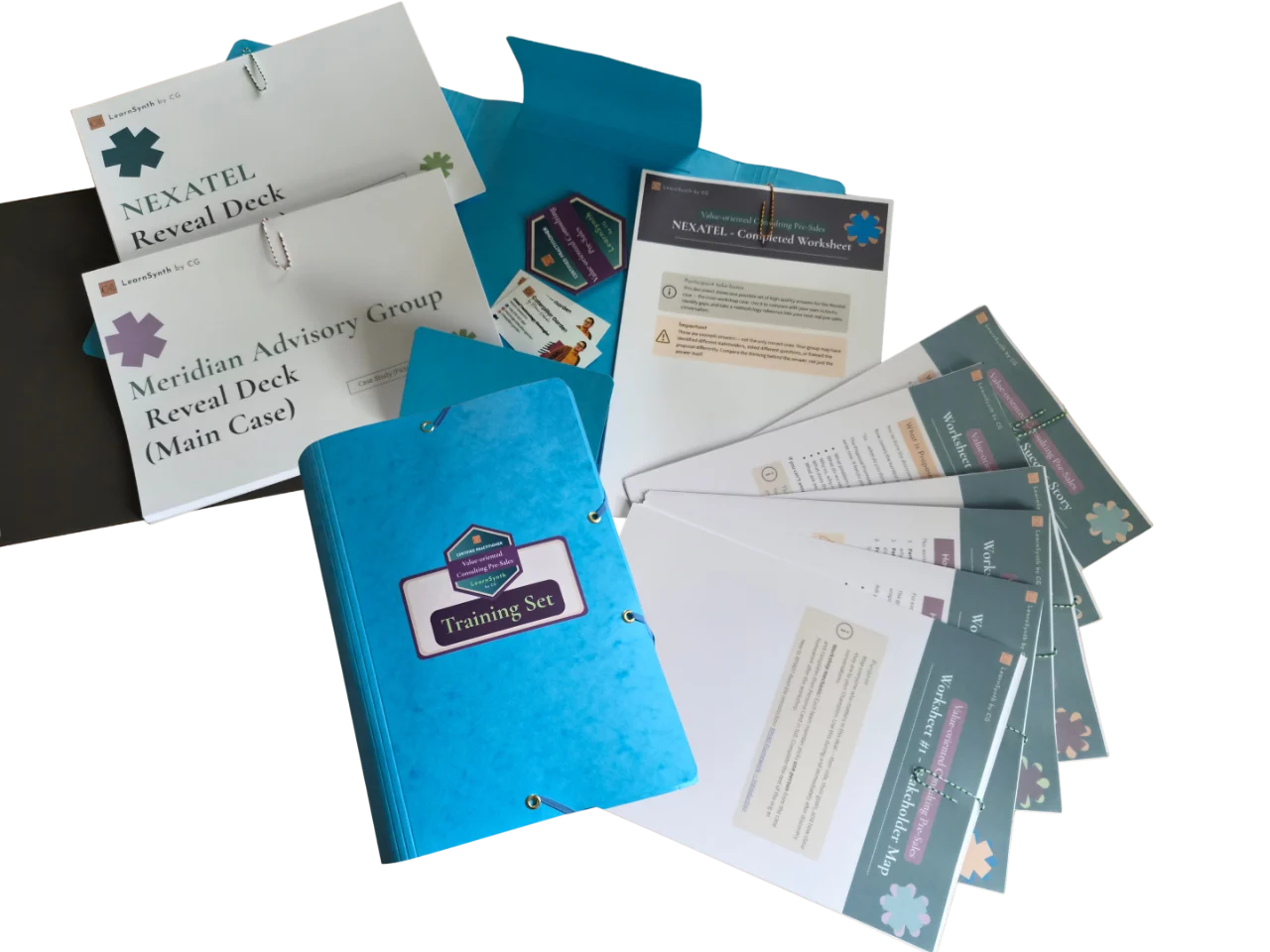
Open cohorts are taught in Polish and priced in gross PLN; B2B prices are net. All formats include: working materials (Org Chart, Goal ID, Diagnostic Questions, Control Letter, Proposal Prompter, Success Story templates), real-world enterprise cases, and a LearnSynth by Caterpillar Garden completion certificate.
The prompts and PDF are in English, but instructions on the landing pages are bilingual. All free, no email required.
Copy a prompt into your AI tool (ChatGPT / Claude). Answer 6 questions — get a tailored recommendation: whether the workshop answers your current challenges, or not right now.
Open the prompt ↗A manager-side prompt: a structured ROI check and organisational readiness assessment based on 2 cost stories and a 0–10 scoring.
Open the prompt ↗A 14-page manager briefing: value proposition, ROI from concrete levers, when the training works (and when it doesn't), 60–90 day metrics, and a post-workshop implementation plan.
Download briefing (PDF, EN) ↗A closed two-day edition for 6–8 people, run in English on-site or online, 20,000 PLN net per group, with a follow-up session 30 days later. Open editions run in Polish — the Polish page has the dates.
On the fence? Email contact@caterpillar.garden or text +48 579 637 860 — I will tell you whether this workshop answers your problem.